Alternatives to Booking Marketplaces for WordPress Restaurants: Take Direct Reservations
Restaurant owners who search for an OpenTable alternative for WordPress or a TheFork alternative are usually not angry with marketplaces. They have looked at how many of their bookings come from guests who already knew the restaurant, and they want those guests to book directly. This article explains the trade-off fairly and gives a practical plan for commission free restaurant booking on your own website, without giving up the discovery a marketplace can bring.
Marketplaces such as OpenTable and TheFork are named here only as examples of the category. Each has its own terms, which change over time, so check the current conditions of any platform you use rather than relying on a blog post.
What a marketplace gives you, and what it costs
The real benefit: discovery
A booking marketplace is a place where diners go when they have not yet decided where to eat. They search by area, cuisine, date and price, and your restaurant appears next to others. For a new opening, a venue in a tourist area or a restaurant with empty midweek tables, that audience has real value. A guest who would never have found you is worth paying for.
Marketplaces also bring reviews, a familiar booking flow that many diners trust, and a mobile app that people already have installed.
The costs that do not appear on the invoice
The fee itself depends on the platform and the plan. The less visible costs are the same across the category:
- Margin on guests you already had. A regular who types your name into a search engine and lands on your marketplace profile is counted like any other marketplace booking. You pay for a guest you did not need help finding.
- Brand. On a marketplace page your restaurant sits inside the design of someone else, one click away from your competitors.
- Guest data. The relationship with the diner is shared with the platform. How much contact data you receive, and what you may do with it, is set by the terms of the platform.
- Dependence. If most of your bookings arrive through one external channel, any change in its terms or ranking becomes your problem overnight.
None of this makes marketplaces a bad deal. It means they are a marketing channel, and they should be judged like one: by what each new guest costs.
Commission free restaurant booking on your own WordPress site
Direct booking means the guest reserves on your website, on your domain, in a form that belongs to you. If your site runs on WordPress, a dedicated plugin does this without an external platform in the middle.
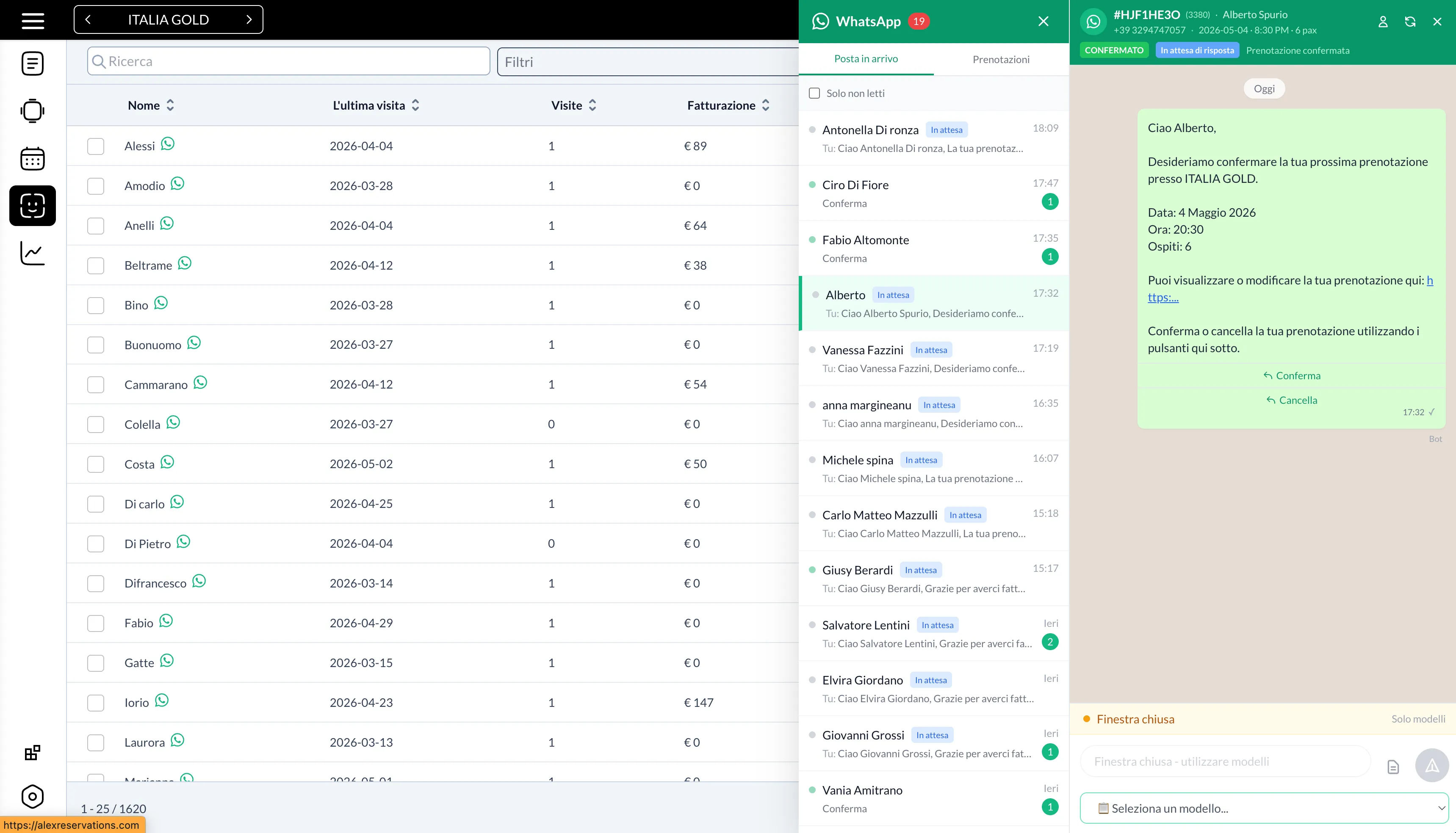
Alex Reservations is one such WordPress restaurant booking plugin. The points relevant to this comparison:
- It runs on your own site and domain. Reservations and guest data are stored in your own WordPress database.
- 0% commission and no per-cover fees. The free version covers one restaurant and up to 30 bookings per month. The PLUS plan is a flat €49 per restaurant per month, whatever the number of covers. Details are on the pricing page.
- It includes the tools a serious booking channel needs: live availability by shift and table, confirmation emails, a customer CRM and, in PLUS, reminders by email and SMS, automatic re-confirmation, deposits and reports.
What direct booking does not do
A plugin on your website does not send you new diners. It converts the people who already reach your site, your social profiles or your phone line. If nobody visits your website, moving the booking form there changes nothing. That is the honest limit of any direct booking tool, and the reason the plan below keeps both channels.
The trade-off side by side
| Marketplace | Direct booking on your site | |
|---|---|---|
| Brings diners who did not know you | Yes, this is its main value | No |
| Cost model | Set by the platform, often tied to bookings or covers | Flat fee or free, independent of covers |
| Where the booking happens | On the page or app of the platform | On your own domain |
| Guest data | Shared with the platform under its terms | In your own database |
| Brand experience | Your profile next to competitors | Your site, your design, your tone |
| Risk if terms change | High if it is your main channel | Low |
A practical plan: keep discovery, make direct the default
You do not have to choose one or the other. The aim is to pay for discovery only when it is real discovery.
1. Make your own site the default place to book
Install the booking form on a dedicated page and link to it from everywhere you control. The tutorial on adding a table booking system to WordPress covers the set-up. Then review each of these and point it to your own booking page:
- The main button on your home page and the menu of your website.
- The website link and booking link in your business listing on maps.
- The link in your Instagram, Facebook and TikTok profiles.
- Your email signature, newsletters and the footer of confirmation emails.
- QR codes on menus, receipts and cards handed out with the bill.
- Your voicemail message and what staff say on the phone: "you can also book on our website".
Guests who contact you by message can be moved to direct booking too. See how reservations by WhatsApp work alongside the form.
2. Keep the marketplace where it pays
Leave your marketplace profile active if it brings guests you would not otherwise reach. If the platform allows it, limit the tables or time slots you offer there to the periods you struggle to fill, and keep peak times for direct bookings. Read your contract first: some platforms set conditions on availability or on prices offered elsewhere.
3. Measure by source
Record where every booking comes from: website, phone, walk-in, WhatsApp, marketplace. Tags and reports in your reservation system make this a matter of routine rather than a monthly spreadsheet exercise. After two or three months, look at four numbers per channel:
- Bookings and covers.
- Total cost of the channel in that period.
- Share of first-time guests against returning guests.
- No-show rate.
Divide the cost of the marketplace by the number of first-time guests it brought. That figure is your real acquisition cost. Compare it with what a new guest is worth to you over a year, and with what the same money would achieve in local advertising or better photography.
4. Bring marketplace guests back directly
A guest who found you through a marketplace and enjoyed the evening should book the second visit with you. Use only what the terms of the platform and data protection law allow, and focus on what happens inside your own restaurant: a card with the bill showing your booking page, a sincere invitation from the staff, and a direct-booking benefit that costs you little, such as a preferred table or early access to special dates.
5. Decide with the numbers
After a full season you will be in one of three situations. The marketplace brings new guests at a fair cost, and you keep it. It brings mostly guests you already had, and you reduce it. Or the picture is mixed, and you keep it for low season only. Each outcome is a decision based on your own data.
Next step
Set up direct booking on your own site this week and start tagging every reservation by source, so that in three months you can make the decision with numbers. You can start a free 14-day trial of the PLUS plan without a credit card, or stay on the free version while you compare channels.